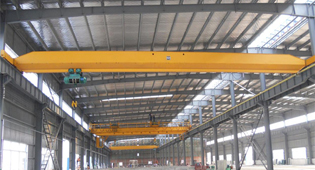
In industrial production and warehousing logistics scenarios, single girder overhead cranes have become the core equipment for material handling in numerous enterprises due to their flexible lifting capacity and high cost-effectiveness. A standardized and efficient installation process is not only the foundation for ensuring the subsequent stable operation of the crane but also the key to building a solid production safety defense line. Combining professional installation standards, this article will break down the 9-step quick installation process of single girder overhead cranes to help relevant operators complete equipment assembly efficiently.
Step 1: Precisely Install and Fix Crane Rails
The rail is the foundation for the operation of the crane's main cart, and its installation accuracy directly affects the operational stability of the equipment. During construction, it is necessary to first conduct precise setting-out and positioning on-site to ensure that the overall levelness and straightness of the rail meet the installation specifications. At the same time, a reasonable expansion joint must be reserved for the rail to avoid rail deformation caused by temperature changes. After that, the rail can be fixed by means of pressure plate welding or bolted pressure plates.
Such crane rails need to have a continuous, flat, and low-friction rolling surface, and sufficient adjustment space must be reserved to facilitate the calibration of rail accuracy in the later stage. Common fixing methods include the pressure plate fixing method, and the combined welding and bolt fixing method.
Step 2: Install the Power Supply Conductor Rail
The power supply system is the source of the crane's power. Before installation, it is necessary to first clarify the orientation of the power supply side, and then complete the fixing of the busbar and current collector. Among them, the red-line conductor rail for power supply is mostly seamless, and its end is equipped with a tensioner, which is used to realize the tension adjustment and end fixing of the conductor rail to ensure the stability of power supply.
In the current collector installation link, it is necessary to strictly control the distance between the current collector and the upper and lower ends of the conductive rail, keeping it within a reasonable range of 70±5mm. At the same time, it is necessary to ensure that the support arm of the current collector is parallel to the sliding line, so as to ensure that the conductor rail has good conductivity and contact, reduce the wear rate of components, and extend the overall service life.
Step 3: Splice the Crane Main Girder
If the length of the main girder of the single girder overhead crane exceeds 11.8 meters, it is usually cut into sections for the convenience of container transportation, and then spliced after arriving at the site. The splicing operation needs to be connected with high-strength bolts. Such bolts can effectively prevent slippage at the connection part, greatly improve the reliability and tightness of the main girder connection, and lay the foundation for the overall structural stability of the crane.
Step 4: Connect the Main Girder and End Carriages
After completing the splicing of the main girder, it is necessary to assemble the main girder and end carriages. The end carriage of each crane is equipped with a motor, a reducer, a driving wheel, and a driven wheel, which are the core components for driving the main cart to walk.
During installation, positioning bolts should be installed first for preliminary positioning and pre-tightening, and then the remaining high-strength bolts should be installed one by one. The motor equipped with the end carriage has a small starting current, which is suitable for the frequent start-stop working conditions of the handling mechanism, and can also achieve energy-saving effects; the end carriage wheel has high overload capacity, smooth rotation, and excellent impact and crack resistance; at the same time, the rubber draft gear on the end carriage can realize smooth buffering without noise and sparks, ensuring the safety of equipment start and stop.
Step 5: Assemble the Electric Hoist
The electric hoist is the lifting core of the crane. During assembly, it is necessary to integrate the hoist itself, lifting and running motors, hooks, trolley wheels and other components into a complete crane trolley.
Among them, the lifting and running motors are mostly conical squirrel cage brake motors, which have the advantages of large starting torque, low noise, and safe and reliable braking; the running motor can also use YSE type electromagnetic brake motors, which can realize smooth start and stop, and have the characteristics of high efficiency and energy saving; while the hooks and trolley wheels have the characteristics of light weight, high precision, and high durability respectively, meeting the needs of various lifting operations.
Step 6: Fix the Electric Hoist to the Main Girder
First, lift the main girder off the ground through the reserved lifting hole on the main girder, and then hoist the assembled electric hoist to the designated position of the main girder. During the installation process, it is necessary to reasonably adjust the spacing of the operating mechanism of the electric hoist, and complete the assembly of the electrical box at the same time, so as to ensure that the electric hoist can walk smoothly on the main girder in the later stage, and the layout of the electrical control circuit is standardized.
Step 7: Install the Angle Steel Chute Towing Cable
The angle steel cable trolley is an auxiliary power supply system for the crane, which has low environmental requirements, runs smoothly, and produces no sparks, making it a highly practical logistics power supply device.
In this link, the installation method of angle steel slide wire, cable slide wire or safety slide wire can be selected according to actual needs. The Q235B angle steel slide rail used has the characteristics of corrosion resistance, not easy to deform, firm and durable; the supporting cable is cold-resistant, wear-resistant, oil-resistant and anti-aging; the angle steel cable trolley is flexible in movement, which not only has a long bearing life, but also will not damage the cable, and can ensure the stable operation of the power supply line.
Step 8: Complete the Electrical System Wiring
Electrical wiring must be operated in strict accordance with the electrical schematic diagram provided by the manufacturer. The electrical control box of the crane will be installed at the designated position of the main girder, and a detailed wiring diagram will be attached to the box. The operator needs to complete the connection of various cables according to the diagram to ensure the smooth signal transmission and power supply of each electrical component, and provide a guarantee for the intelligent control and safe operation of the crane.
Step 9: Overall Hoisting and Positioning
The last step is to use lifting equipment such as a mobile crane to hoist the assembled crane as a whole to the designated installation position. If the lifting height exceeds the existing crane on-site, the crane can be controlled to rotate by pulling the traction rope, and then lowered smoothly after the sheave groove is aligned with the rail.
It should be noted that single girder overhead cranes are mostly installed inside warehouses, and most customers do not have sufficient height for lifting operations on-site. Therefore, it is necessary to reserve some uncovered roof areas in advance to create conditions for the overall hoisting operation.
The installation of a single girder overhead crane is a project with both professionalism and rigor, and each step must be carried out in strict accordance with specifications. If technical problems are encountered during the installation process, you can
consult us at any time to obtain free technical guidance to ensure the smooth commissioning of the equipment.