When purchasing a hoist for an overhead crane or gantry crane, lifting capacity is usually the first specification buyers check. However, for factories with frequent lifting operations, other factors can be just as important. Available headroom, lifting speed, positioning accuracy, maintenance access, and working duty all affect how well the equipment performs in daily production.
This is one reason why European hoists have attracted attention from industrial buyers looking for a more compact and efficient lifting solution.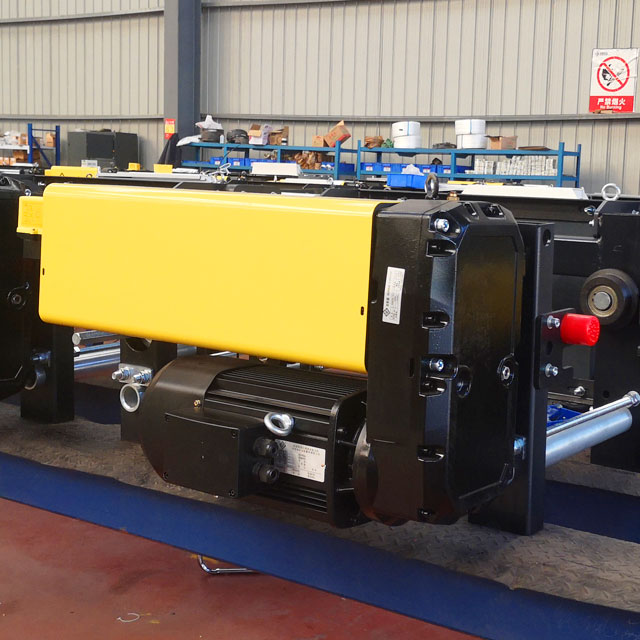
Workshop space is not always easy to expand. In some factories, the building height is fixed, and the distance between the crane girder and roof structure is limited.
A European hoist typically uses a more compact mechanical arrangement. Depending on the model and trolley configuration, its low-headroom design can help improve the available lifting height and hook approach.
For buyers, this means it is worth checking more than the overall hoist dimensions. The actual hook lifting height, headroom, and approach distance should be confirmed before ordering.
When handling machinery parts, steel components, molds, or finished products, sudden starting and stopping can make load positioning difficult.
European hoists can be configured with two-speed or variable-frequency control, depending on the model. These options allow operators to adjust lifting and traveling movements more smoothly.
For production lines requiring accurate positioning, a variable-frequency drive may be worth considering. It can provide controlled acceleration and deceleration, helping reduce unnecessary load movement during operation.
Two hoists with the same rated capacity do not necessarily have the same working capability.
A hoist used for occasional lifting in a warehouse has different requirements from one operating repeatedly throughout a manufacturing shift.
Before selecting a European hoist, buyers should confirm:
Rated lifting capacity
Average load handled during operation
Number of lifting cycles per hour or shift
Daily operating hours
Required lifting speed
Applicable FEM or ISO duty classification
Choosing a suitable duty class helps avoid selecting equipment that is undersized for the actual workload.
A hoist is made up of several components that work as one system, including the lifting motor, gearbox, brake, wire rope, drum, hook assembly, and electrical controls.
Buyers should pay attention to overload protection, lifting limit switches, braking performance, and motor protection. The exact safety configuration should be confirmed against the project requirements and applicable standards.
Maintenance access is another practical consideration. Components that are easy to inspect and replace can help reduce service time when maintenance is required.
It is also worth asking the supplier about spare parts availability, recommended inspection intervals, and technical support after delivery.
This is a common question when a factory wants to upgrade its lifting equipment without replacing the entire crane.
In some cases, a European hoist can be installed on an existing overhead crane or gantry crane. However, compatibility must be checked before ordering.
Important details include:
Existing crane capacity and duty class
Girder dimensions and trolley arrangement
Available headroom
Rail or beam specifications
Wheel loads and structural limitations
Power supply and control system
A replacement hoist should not be selected by capacity alone. The supporting structure and traveling mechanism must also be suitable for the new equipment.
HY Crane provides European-style hoist solutions for industrial lifting applications, including overhead cranes, gantry cranes, and other material handling systems.
Customers can discuss the required capacity, lifting height, lifting speed, working duty, installation arrangement, and power supply with the technical team before selecting a configuration.
For an existing crane replacement project, drawings, photos, and basic dimensions of the current hoist and trolley are useful starting points.
The goal is to select a hoist that fits the actual working conditions rather than simply choosing a model with a higher rated capacity.
A European hoist is worth considering when workshop space, smooth operation, lifting accuracy, and working frequency are important to the project.
Before making a purchase, compare the complete configuration, including duty classification, headroom, control system, safety devices, maintenance requirements, and installation compatibility.
A suitable hoist should fit both the crane structure and the production process. That is what makes the difference between simply buying lifting equipment and choosing a practical long-term solution.
1. What is a European hoist?
A European hoist is an industrial lifting mechanism featuring a compact design and configurable lifting and traveling systems. Specific models may be designed according to FEM, ISO, or other applicable standards.
2. What is the main advantage of a European hoist?
Its compact arrangement and available low-headroom configurations can help make better use of workshop space. Variable-speed options can also support smoother load handling.
3. Can a European hoist replace a traditional wire rope hoist?
In some applications, yes. However, capacity, duty class, headroom, trolley dimensions, wheel loads, and electrical compatibility must be checked first.
4. What information is needed to select a European hoist?
Buyers should provide lifting capacity, lifting height, operating frequency, required speed, installation type, power supply, and working environment. Existing crane drawings are helpful for replacement projects.