Overhead cranes are widely used in South African factories, workshops, steel plants, warehouses, mines, and other industrial facilities where heavy materials need to be moved on a regular basis. For many companies, the crane is not simply a lifting machine. It is part of the daily production process.
A crane that is too slow can delay production. A poorly matched hoist can create unnecessary maintenance work. A crane selected without considering the building structure may also require expensive modifications before installation.
For this reason, buying an overhead crane in South Africa should start with the actual working conditions rather than a standard crane catalogue.
An overhead crane is a lifting system that operates above the working floor on an elevated runway. The main bridge travels along the runway, while a hoist or trolley moves across the bridge to lift and position loads.
This arrangement keeps the floor relatively clear and allows heavy materials to be moved across a defined production area.
Typical overhead crane components include:
Bridge girder
End trucks
Hoist or trolley
Electric motor
Wire rope or chain
Hook
Control system
Electrical equipment
Runway system
The exact configuration depends on the load, span, lifting height, working frequency, and site conditions.
South Africa has a broad industrial base, so overhead cranes are used in a number of different applications.
Machine shops and engineering companies often use overhead cranes to move motors, molds, fabricated steel parts, machinery, and other heavy components.
In these environments, accurate positioning can be just as important as lifting capacity. A crane used to place a machine component on an assembly line, for example, may benefit from variable-speed control and smooth acceleration.
Steel plants and metal fabrication facilities handle heavy plates, beams, coils, pipes, and finished structures.
These applications often require heavy-duty overhead cranes with suitable lifting attachments. Magnets, grabs, C-hooks, and spreader beams may be used depending on the material being handled.
Mining is an important part of South Africa's industrial economy, and lifting equipment is used in workshops, processing facilities, maintenance areas, and material handling operations.
Mining-related crane applications can involve dust, long working hours, high loads, and demanding maintenance schedules. Crane components therefore need to be selected according to the actual environment rather than based only on rated capacity.
An overhead crane can be useful when a warehouse handles loads that are too heavy or awkward for conventional forklifts.
The crane can move materials between storage areas, loading zones, and workstations while keeping the floor available for other activities.
Power stations, fabrication yards, and infrastructure projects may require cranes for equipment installation, maintenance, and assembly.
In these cases, lifting height, hook approach, access for maintenance, and the dimensions of the building can have a major influence on crane design.
There is no single overhead crane configuration suitable for every South African industrial facility. The right choice depends on the application.
A single girder overhead crane uses one main bridge girder and is commonly selected for light and medium-duty lifting.
It can be a practical option for:
Manufacturing workshops
Warehouses
Maintenance bays
Machinery plants
General material handling
One of its main advantages is relatively simple construction. For projects where the required capacity and duty do not justify a heavier crane, a single girder design can help control the initial investment..jpg)
A double girder overhead crane has two main bridge girders and is normally considered for heavier applications.
It can provide greater lifting capacity, longer spans, and more flexibility in hoist and trolley arrangements.
Typical applications include:
Steel plants
Heavy machinery manufacturing
Foundries
Mining facilities
Large fabrication workshops
For high-capacity projects, the crane structure and building reactions need to be reviewed together. Increasing the crane capacity without checking the supporting structure is not a sound approach.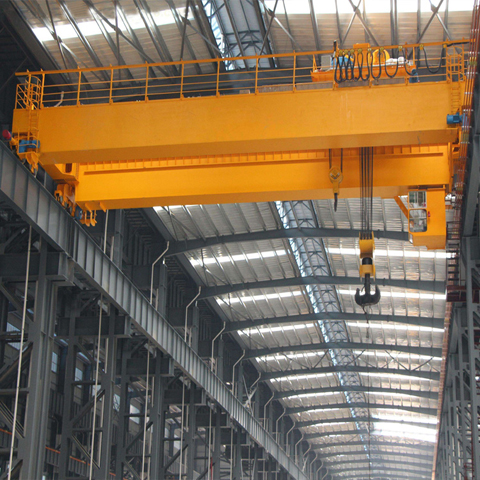
European-style overhead cranes focus on compact dimensions, lower headroom, efficient drives, and modern control systems.
They can be useful where building height is limited or where the customer wants to make better use of the available lifting height.
The actual benefits depend on the building layout and required duty, so a European design should still be evaluated as a complete crane system rather than selected simply because it is marketed as a newer type.
A top-running crane travels on rails installed on top of the runway beams. This arrangement is common in industrial facilities and can accommodate a wide range of capacities and spans.
It is particularly suitable when the building has a suitable runway structure and sufficient clearance.
Choosing a crane starts with a few basic numbers, but there are several details that should not be overlooked.
Start with the heaviest load that the crane will regularly handle.
Remember to account for lifting accessories such as:
Hooks
Slings
Spreader beams
Magnets
Grabs
Special lifting devices
It is also useful to separate normal production loads from occasional maintenance lifts. Designing the entire crane around a rare load can unnecessarily increase the equipment cost.
The crane span is the distance between the runway rails.
A longer span can affect:
Girder design
Crane weight
Wheel loads
Building reactions
Crane cost
Accurate building measurements are therefore important before requesting a final quotation.
Hook height determines whether the crane can place a load where it needs to go.
In a building with limited headroom, the hoist design becomes particularly important. A low-headroom hoist or compact crane configuration may provide more usable lifting height without major building modifications.
A crane used for occasional maintenance does not experience the same operating conditions as one running throughout multiple production shifts.
Consider:
Lifts per hour
Average load
Maximum load
Daily operating hours
Travel distance
Number of working shifts
These factors influence the selection of the hoist, motors, brakes, electrical system, and crane structure.
The installation environment should be included in the technical specification.
For indoor applications, factors such as dust, heat, humidity, and ventilation may affect equipment selection.
Outdoor or partially exposed applications require additional consideration of rain, wind, corrosion, drainage, and electrical protection.
For mining and heavy industrial environments, the crane may need a more robust configuration and a maintenance plan suited to the site.
The power supply available at the plant should be confirmed before finalizing the crane.
An industrial overhead crane may use:
Pendant control
Radio remote control
Cabin control
Variable frequency drives
PLC-based control systems
Radio remote control can give operators more freedom to position themselves where they have a better view of the load.
Pendant control remains a straightforward option for many workshops.
For applications requiring frequent starts, stops, and precise positioning, variable frequency drives can provide smoother crane and trolley movement.
The best control method depends on the working process. There is little value in adding sophisticated controls if the application does not need them.
Price comparisons between different crane suppliers can be misleading if the technical scope is not the same.
A South African buyer should ask suppliers to clearly state:
Rated lifting capacity
Crane span
Lifting height
Lifting speed
Long travel speed
Cross travel speed
Working duty
Power supply
Control method
Runway requirements
Installation scope
Testing and commissioning
Spare parts
Warranty
After-sales service
Building reactions and wheel loads are particularly important when a new runway system or building modification is involved.
A quotation that only says "10-ton overhead crane" does not provide enough information for a proper technical comparison.
Installation should be considered early in the project.
Before the crane arrives, the project team should confirm:
Building dimensions
Runway beam condition
Rail alignment
Power supply
Access for transportation
Installation equipment
Lifting access
Electrical connections
Testing requirements
For a new crane, the installation area should be ready before equipment delivery. Delays caused by unfinished civil work or electrical connections can increase project costs even when the crane itself is ready.
For imported equipment, transportation and customs arrangements should also be considered as part of the project schedule.
Regular maintenance is essential for keeping an overhead crane available for production.
Common inspection points include:
Wire rope
Hook and hook block
Brakes
Wheels
Gearboxes
Motors
Electrical connections
Limit switches
Control equipment
Structural connections
The inspection frequency should reflect the crane's duty and working environment.
A crane operating several shifts a day in a demanding industrial facility needs a different maintenance approach from a crane used occasionally for workshop maintenance.
Keeping commonly required spare parts on hand can also shorten downtime when a component needs replacement.
There is no standard price for an overhead crane because the final cost depends on the complete configuration.
Important cost factors include:
Lifting capacity
Span
Lifting height
Crane duty
Hoist type
Control system
Runway requirements
Installation conditions
Special lifting attachments
Transportation
Installation and commissioning
For this reason, an online "10-ton crane price" should only be treated as a rough reference.
A more useful quotation is based on the customer's actual working conditions and includes a clearly defined technical scope.
HY Crane provides overhead cranes and material handling equipment for industrial applications, including single girder and double girder crane solutions.
The project can be developed around the customer's:
Load requirements
Factory layout
Span
Lifting height
Working duty
Operating environment
Power supply
Control requirements
For buyers in South Africa, providing accurate project information at the quotation stage makes it easier to compare crane configurations and avoid unnecessary changes later.
HY Crane can support customers with technical discussions, crane configuration, manufacturing, delivery, commissioning support, training, spare parts, and after-sales service.
The right overhead crane for a South African factory is not necessarily the crane with the highest lifting capacity or the lowest initial price.
A better choice is one that matches the production process, building structure, operating environment, and expected workload.
Before requesting a quotation, prepare the basic project information: load capacity, span, lifting height, travel distance, working hours, load type, power supply, and installation conditions. The more complete the information, the easier it is for a crane manufacturer to provide a useful technical proposal.
If you are planning an overhead crane project in South Africa, HY Crane can review your requirements and recommend a suitable crane configuration based on the actual application.
Single girder and double girder overhead cranes are both widely applicable. The choice depends mainly on lifting capacity, span, duty, lifting height, and the factory's operating conditions.
A single girder crane is generally suitable for light and medium-duty applications. A double girder crane is more appropriate when higher capacity, longer spans, greater lifting height, or heavier working duty is required.
Yes. Overhead cranes can be used in mining workshops and processing facilities, but dust, temperature, operating frequency, corrosion, and maintenance conditions should be included in the design.
It depends on the existing building. Engineers should check runway beams, columns, clearance, wheel loads, power supply, and installation access before confirming the crane configuration.
At minimum, provide the required lifting capacity, span, lifting height, travel distance, working frequency, load type, power supply, operating environment, and available building drawings.