In modern logistics and industrial operations, efficient material handling equipment is essential for improving productivity and reducing operational costs. As cargo volumes continue to increase, traditional lifting equipment often cannot meet the requirements of large-scale container yards, terminals, and industrial storage facilities.
Rail mounted gantry cranes (RMG cranes) have become one of the most widely used solutions for high-efficiency material handling. With a rail-mounted traveling system, these cranes can move accurately along fixed tracks and provide excellent stability, high lifting capacity, and efficient operation over large working areas.
Rail mounted gantry cranes are commonly used in container terminals, railway freight yards, logistics centers, shipyards, and large industrial facilities. Their ability to combine automation, precision positioning, and high productivity makes them an important part of modern material handling systems.
This guide explains what rail mounted gantry cranes are, how they work, their advantages, applications, and key factors to consider when selecting an RMG crane.
A rail mounted gantry crane (RMG crane) is a type of gantry crane that travels on rails installed on the ground. Unlike rubber tired gantry cranes (RTG cranes), which use tires for movement, RMG cranes operate on fixed rail tracks, providing more accurate positioning and higher operational stability.
An RMG crane usually consists of:
The crane moves along parallel rails while the trolley travels across the bridge structure. This allows containers or heavy materials to be lifted, transported, and stacked efficiently within a defined working area.
Rail mounted gantry cranes are especially suitable for applications requiring:
The operation principle of an RMG crane is based on coordinated movement between three main systems:
The entire gantry structure moves along ground rails through electric motors and wheel assemblies.
The rail-mounted design ensures:
Compared with mobile cranes, RMG cranes are designed for fixed working areas where continuous material handling is required.
The trolley moves horizontally along the main girder.
This movement allows the crane to position loads precisely within the working range.
The hoisting mechanism performs vertical lifting operations.
Depending on the application, RMG cranes may use:
For container terminals, automatic spreaders are commonly used to handle 20 ft, 40 ft, and 45 ft containers.
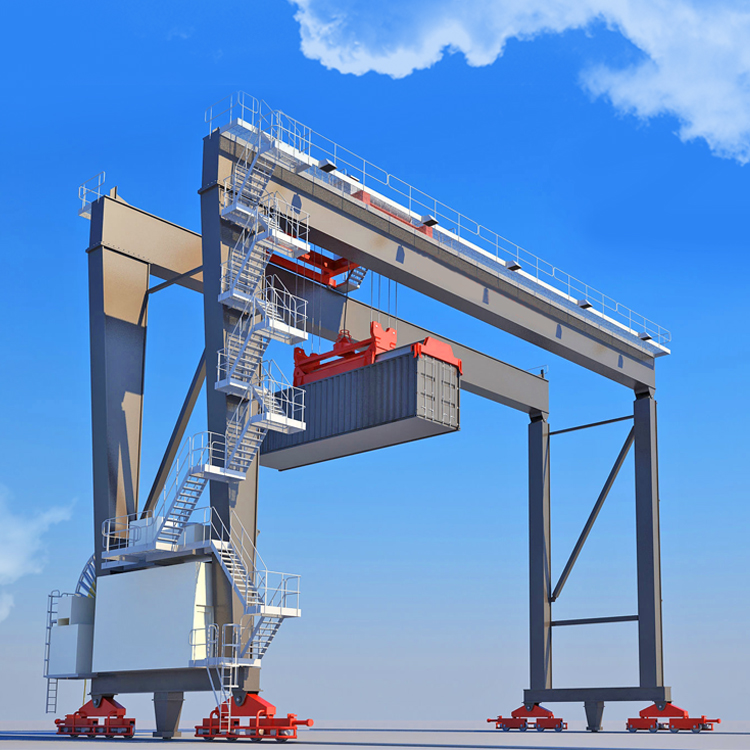
The steel structure is the main load-bearing part of the RMG crane.
It includes:
The structure is designed according to:
High-quality welded structures ensure long service life and stable operation under heavy loads.
The hoisting system determines the crane's lifting performance.
A typical RMG crane includes:
For heavy-duty applications, multiple protection systems are usually installed to improve operational safety.
The traveling mechanism enables the crane to move along fixed rails.
It includes:
Compared with tire-based systems, rail traveling provides better energy efficiency and lower maintenance requirements.
Modern rail mounted gantry cranes often use advanced control systems.
Available options include:
Automation features can improve:
One of the biggest advantages of RMG cranes is their ability to handle large volumes of materials continuously.
In container terminals and logistics yards, RMG cranes can perform repeated lifting operations with high efficiency.
Compared with conventional lifting equipment, they provide:
Because RMG cranes travel on fixed rails, their movement is highly controlled.
Benefits include:
This is especially important for container stacking operations where precise placement is required.
Rail mounted gantry cranes can operate within narrow corridors and maximize storage density.
Compared with traditional mobile equipment, RMG systems allow:
This makes them ideal for:
Although the initial investment of an RMG crane may be higher than some mobile lifting equipment, it often provides better long-term economic benefits.
Advantages include:
For facilities with continuous operations, RMG cranes can provide a better total cost of ownership.
Rail mounted gantry cranes are highly compatible with automated systems.
Modern automated RMG cranes can include:
Automation helps improve productivity while reducing safety risks caused by manual operation.
Container handling is the most common application of RMG cranes.
They are used for:
Large ports and inland container terminals often use RMG cranes to improve handling efficiency.
Rail mounted gantry cranes are widely used in intermodal transportation yards.
They can efficiently transfer containers between:
This improves the connection between railway and road transportation systems.
Large logistics facilities use RMG cranes for organized storage and transportation of goods.
Advantages include:
Besides container applications, customized RMG cranes can also be used in industrial environments.
Examples include:
A common question from buyers is the difference between RMG cranes and RTG cranes.
| Feature | Rail Mounted Gantry Crane | Rubber Tired Gantry Crane |
|---|---|---|
| Traveling method | Fixed rails | Rubber tires |
| Movement flexibility | Fixed route | Flexible movement |
| Position accuracy | Higher | Lower |
| Automation capability | Excellent | Moderate |
| Maintenance | Lower | Higher |
| Energy efficiency | Better | Depends on power system |
| Best application | Large fixed yards | Flexible container yards |
The choice depends on the operation model, site layout, and future development plan.
Selecting an RMG crane requires careful consideration of several technical factors.
The required lifting capacity depends on the maximum load weight.
For container applications, common requirements include:
Industrial applications may require different capacities based on material handling needs.
The crane span affects the coverage area.
Important factors include:
A professional manufacturer can design the crane according to the actual site conditions.
The duty cycle determines the structural design requirements.
A crane operating:
will require different designs and components.
Before purchasing, companies should consider future upgrades.
Possible options include:
Planning automation at the beginning can reduce future modification costs.
Outdoor RMG cranes may face:
Required protection may include:
HY Crane specializes in manufacturing industrial lifting equipment and customized crane solutions for global customers.
With professional engineering capability and advanced manufacturing technology, HY Crane provides rail mounted gantry cranes designed according to:
Our RMG crane solutions are suitable for:
From engineering design and manufacturing to installation support and after-sales service, HY Crane helps customers build reliable and efficient material handling systems.
Rail mounted gantry cranes are an efficient and reliable solution for modern container handling and industrial material transportation.
With advantages including high stability, accurate positioning, excellent space utilization, and automation capability, RMG cranes have become an essential choice for ports, logistics centers, railway terminals, and heavy industrial facilities.
When selecting an RMG crane, buyers should consider not only the initial investment but also lifting capacity, working frequency, automation requirements, and long-term operating costs.
Choosing the right rail mounted gantry crane manufacturer can significantly improve operational efficiency and provide long-term value for industrial projects.
A rail mounted gantry crane is a gantry crane that travels on fixed rails and is mainly used for container handling, logistics yards, and industrial material transportation.
RMG cranes run on rails and provide higher accuracy and automation capability, while RTG cranes use tires and offer greater mobility.
RMG cranes are widely used in container terminals, railway freight yards, logistics centers, shipyards, and industrial storage facilities.
Yes. Modern RMG cranes can be equipped with automated control systems, remote operation, and intelligent management functions.
With proper design, maintenance, and operation, a rail mounted gantry crane can provide decades of reliable service in industrial environments.