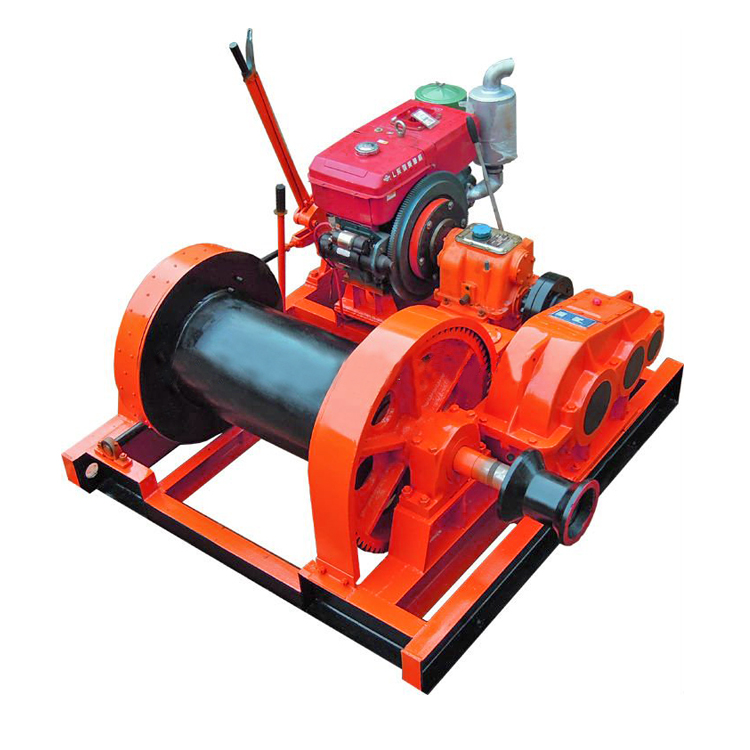
Among numerous construction machinery and operating equipment, diesel-powered winches play an indispensable role in specific fields due to their unique power source and strong adaptability. This article aims to systematically analyze the comprehensive performance, wide range of applications, and outstanding characteristics of this type of equipment compared to other power forms, providing you with an excellent and clear understanding.
I. Core Performance Analysis
The core performance of a
diesel-powered winch stems from the coordinated work of its power system and mechanical structure. We can understand this from the following key dimensions:
1. Power and Torque Characteristics: Diesel engines are known for their low-speed, high-torque output characteristics. This power characteristic ensures good reliability and stability when lifting and dragging heavy objects.
2. Continuous Operation and Endurance: Thanks to the high fuel energy density and engine design, diesel-powered winches usually have excellent continuous working capabilities.
3. Environmental Adaptability and Reliability: Diesel engines have strong adaptability to complex environments. In conditions with large temperature variations, high dust levels, or high humidity, their operation is usually more stable than some sophisticated power systems.
4. Speed Control and Handling Performance: Modern diesel-powered winches are usually equipped with mature transmission and control systems. Operators can achieve relatively precise control of the winch speed through the cooperation of the throttle, clutch, and braking devices, meeting the needs for slow, precise positioning or rapid cable retraction and release under different working conditions.
5. Fuel Economy and Energy Density: When completing the same amount of work, diesel fuel consumption costs usually have a certain advantage. Especially in situations where electricity is not readily available at fixed sites or on mobile equipment, the self-contained fuel supply provides great operational freedom, and its energy reserve (fuel tank capacity) directly determines the duration of continuous operation.
II. Exploration of Typical Application Scenarios
Diesel-powered winches have a wide range of applications, and their "self-contained power and flexible mobility" characteristics make them a preferred solution in many fields.
1. Construction Engineering and Construction Sites: In the early stages of construction sites where power infrastructure is not yet complete, or in remote construction locations, diesel winches are often used to lift building materials (such as rebar, formwork), assist in heavy object traction during pile foundation construction, and assist in the installation and positioning of large components. 2. Mining and Resource Exploration: Mining environments are complex, and power supply may be limited. Diesel winches are used for material lifting in mine shafts, equipment relocation, and auxiliary operations for exploration drilling rigs. Their robust design allows them to adapt to harsh working conditions.
3. Forestry and Timber Harvesting: In mountainous forest areas, they are used for dragging logs, collecting timber, and loading trucks. Their powerful traction and off-road mobility enable them to cope with the rugged and uneven terrain and lack of power grid coverage in forest areas.
4. Shipyards and Port Operations: As marine machinery or port auxiliary equipment, they are used for mooring and anchoring ships, as well as lifting small cargo or towing vessels in areas of the port without electricity.
5. Emergency Rescue and Special Operations: During rescue operations after natural disasters, power outages are common. Diesel-powered winches can be quickly deployed to clear roadblocks, tow overturned vehicles, or set up temporary lifting facilities. They are also frequently seen in special engineering projects such as large-scale equipment installation and bridge maintenance.
6. Agriculture and Water Conservancy Engineering: Used for the construction and maintenance of large-scale agricultural and water conservancy facilities, such as opening and closing sluice gates, towing heavy agricultural machinery, and moving heavy materials across vast farmlands.
III. Detailed Explanation of Comprehensive Advantages
Choosing a diesel-powered winch is often based on a consideration of its comprehensive advantages. These advantages are particularly evident when compared to electric and gasoline-powered winches.
1. Strong operational autonomy, not limited by the power grid: This is its most significant advantage. The equipment carries its own power source, eliminating the need for external power supply, allowing it to work independently in any location far from the power grid, greatly expanding the operating radius and application scenarios, especially suitable for field, mobile, and temporary projects.
2. High traction force and strong load capacity: The torque characteristics of diesel engines are naturally suited for heavy-duty starting and continuous load operation, making them more effortless and reliable when handling large-tonnage, high-intensity traction and lifting tasks.
3. High durability and relatively simple maintenance: Diesel engines have a robust structure, and the design of their main systems (such as the fuel system and lubrication system) has become very mature over many years of development. The routine maintenance and upkeep procedures are straightforward, requiring a relatively balanced level of technical expertise from maintenance personnel, and the equipment has a long service life.
4. Operating costs have certain economic advantages: Although the initial purchase cost requires comprehensive evaluation, in long-term, high-intensity use, the fuel consumption cost of diesel and the durability of the equipment itself often demonstrate better overall economic efficiency. Its energy efficiency ratio is particularly outstanding under high-load operating conditions.
5. Safety considerations: In flammable and explosive environments, the choice of power source requires extreme caution. However, in conventional outdoor or well-ventilated environments, diesel has a higher flash point than gasoline, giving it certain safety advantages. Stable power output also reduces the safety risks that may arise from sudden power interruptions.
Conclusion
In summary, diesel-powered winches are a type of engineering equipment whose core values are powerful independent power, user-satisfactory environmental adaptability, and reliable heavy-duty performance. Its performance characteristics determine its irreplaceable role in areas without stable power supply, complex working conditions, and high traction force requirements. When considering its selection, users should make a reasonable judgment based on their actual application scenarios, operating frequency, load requirements, and overall costs.